

Land Rover propshafts - some useful information
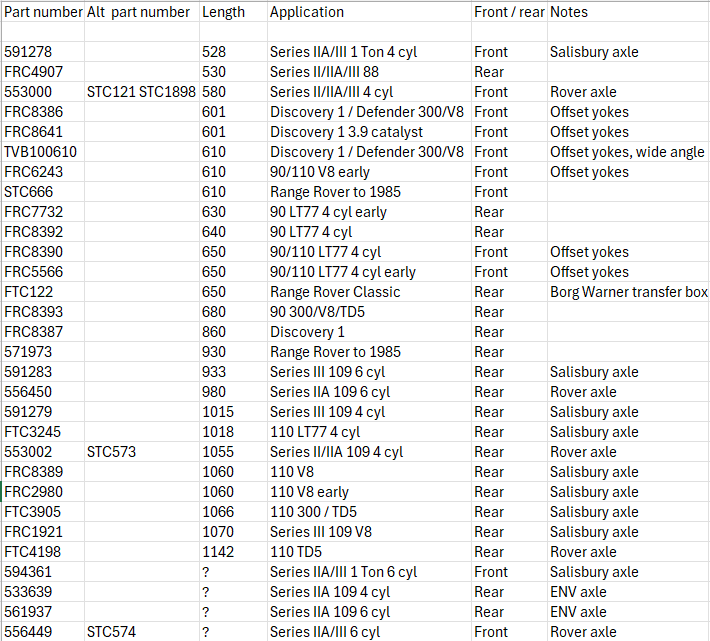
When I came to clear out my old workshop, about a dozen propshafts ended up in the scrap bin. There was nothing wrong with them: but I hadn’t labelled them for identification, had no way of knowing what vehicle they had come from or whether they were front or rear props. Over the years I have sometimes needed a non-standard propshaft length for various conversions, and again without any data it is hard to know which of the many different Land Rover propshafts will do the job. So I put together the table below which I hope people will find useful.
I have confined myself here to one-piece propshafts with the standard Land Rover four bolt yoke at both ends (79.4mm PCD, 3/8” bolt holes). There are various more unusual propshafts such as the 109 V8 and Discovery 2 (double cardan joint at one end) and more recently Land Rover have moved away from using the same universal joint and yokes on absolutely everything, so the newer stuff is not interchangeable in the same way. The figures are all for closed length, i.e the two sections of the propshaft pushed together. The data has been gathered from various sources including AI searches: I have done my best to make sure it is accurate, but if you spot any errors (or can add any more propshafts to the list) please let me know. There are a few of the more obscure propshafts that I haven’t been able to find the closed length for: Series IIA/III 6 cylinder front props, and rears on IIA 109s with the very rare ENV back axle.
Most propshafts have the yokes at each end aligned with each other. However the weird suspension and axle geometry on coil-sprung Land Rovers results in the front propshaft on these vehicles having yokes which are offset, i.e. the cups do not directly line up end to end. These are not really suitable for use on the rear axle: you’ll get away with it but at the cost of a bit of vibration, and the joints will most likely have a shorter life than they should. The table shows which propshafts have offset yokes. It also lists axle types where appropriate: the Salisbury axle is a good bit longer from axle centre to drive flange than the Rover type and therefore needs a shorter propshaft.
A few general comments: all these propshafts use standard Hardy-Spicer universal joints with the bearing cups retained by circlips on the outer ends. Land Rover used two sizes of joint: 2 15/16” / 75mm across the cups (RTC3458) and 3 3/16” / 81mm (RTC3346). Series One, II and early IIA used 75mm joints: the factory then went over to 81mm on pretty much everything until around 1986 where they reverted to 75mm. These joints were always a bit of a drivetrain weak spot: they need regular greasing (except the ones on cheap new propshafts which don’t have grease nipples) and even then they can wear quite rapidly in very dusty conditions. I had a customer who was running a Defender mostly offroad out on the Brecks, and about every six months the sandy soil killed a propshaft joint.
Usually a failing joint makes itself known via a squeaking sound from underneath which varies with load and speed. You can check the joints by jacking up one end (with wheels chocked at the other) and trying to turn the propshaft back and forth. Play in the joints should be obvious. Sometimes a joint can seize almost solid, in which case there will be no play but you might feel the propshaft no longer rotates smoothly but has a sticky patch on each rotation. Also look out for reddish-brown rust staining on the inner ends of the cups: this is a sure sign of a joint which is grinding its needle roller bearings to powder, probably because it hasn’t been greased since new.
New joints are cheap enough that it is only worth buying the GKN ones. Whether you change a joint or the entire propshaft will depend on (1) whether the yokes are damaged (unusual unless a cup has disintegrated) and (2) the condition of the sliding spline section. Wear here will tend to make the propshaft run out of true and vibrate. The splines, like the UJs, need regular greasing. Later propshafts often have nylon-coated splines. This was supposed to reduce friction and wear, but water can creep under the coating and the resulting corrosion expands the plastic and locks the sliding section solid. This can be hard to detect without removing the propshaft, but will chew up one of the joints before long so you will find it when you remove the propshaft to change the joint.
I have my own way of changing joints. Rather than messing around trying to prise the rusty circlips out of their slots and then pressing the cups this way and that to extract them outwards, I cut through the joint spider with a thin cutting disc (taking care not to cut into the yokes) and then knock the cups inwards, after which removing the circlips is child’s play. To fit a new joint you will need a bench vise with nice wide opening jaws, or a hydraulic press. Clean the yoke surfaces, scrape any debris out of the circlip grooves and use plenty of grease. The important thing here is to make sure that none of the needle rollers inside the cups become displaced while you are fitting the joint: if you start hitting the thing with a hammer you will end up with a roller or two lying across the bottom of the cup, which means you won’t be able to get the circlips in. Take great care to ensure you press the cups into the yokes absolutely square: if even slightly skewed they tend to stick and then free off with a bang as you apply more pressure, which is just the excuse the rollers were looking for to exit the chat. It doesn’t help that the outer surface of the outer yoke is angled rather than square to the cups. Why did Solihull do that? Anyway, on to the table.
If you have found this information useful, please consider supporting my work by buying me a virtual coffee here.